
4 min read
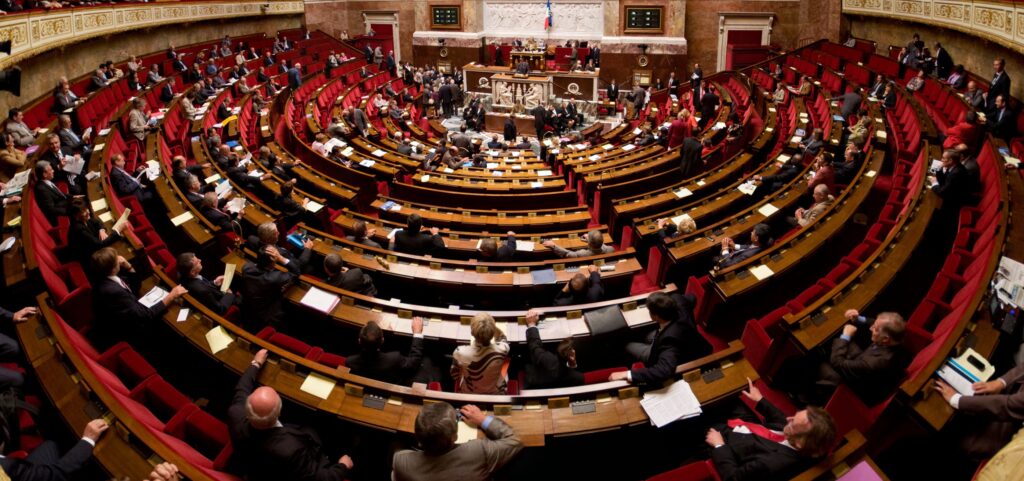
Due for examination in public sitting at the National Assembly from Monday 29 June 2026, the bill on the organisation, governance and financing of professional sport has attracted more than 350 tabled amendments. The essentials come down to a handful of knots.
Broadcasting rights: the free-to-air obligation in the crosshairs. The obligation to reserve one package for the free-to-air broadcast of at least one event per week is the target of a repeal offensive from part of the majority and the right-wing opposition (Dirx, Nos. 355 and 356; Bodart, No. 212; Fait, No. 59), doubled by a broad coalition — LIOT, DR, HOR — seeking to restore the freedom to structure rights packages adopted by the Senate (Viry, Nos. 31/32; Duby-Muller, Nos. 19/20; Firmin Le Bodo, No. 120). This is precisely the first of the two main points professional sport stakeholders want rewritten: the obligation to broadcast one match per week free-to-air which, they argue, would erode the value of the rights, since free public access is already guaranteed by short extracts and the list of events of major importance.
The « club-owned company » and the economics of revenue sharing (arts. 6 and 7). Rapporteur Belhaddad sets the architecture of the future commercial vehicle: equality between clubs on political and economic rights (No. 265), independence of executives from shareholders (No. 266), a maximum revenue-sharing ratio of 1 to 3 written into law (No. 268). In support, LIOT and DR are pushing for a federation veto right, mandatory federation seats on the board and an anti-« closed leagues » mechanism (Viry, Nos. 35/37/38). On revenue sharing, the lines diverge: the left wants to tighten the ratio to 1 to 2 and fold in international rights (Bourouaha, Nos. 287/286), others want to remove any legal floor and refer the matter to decree (Lingemann, No. 224). Above all, the capping of payroll at 65 % of budget — the second point contested by professional sport stakeholders — faces a converging wave of deletion amendments: EPR (Dirx, No. 351), HOR (Firmin Le Bodo, No. 338), rapporteur Duparay (No. 105) and LIOT (Bodart, No. 215). With majority and rapporteur converging, it should be removed from the text, at least in so precise a form.
Multi-club ownership and control of acquisitions (art. 9). Rapporteur Duparay holds the executive line: strengthening the control of equity stakes and changes of ownership without banning multi-club ownership (No. 109, co-signed by DEM, LFI and SOC members — a rare convergence), and allowing the DNCG, French football’s financial watchdog, to issue a reasoned opinion and to object (No. 101). Facing this, several groups want to preserve the DNCG’s autonomy and avoid engaging the minister’s responsibility over club ownership. Also worth noting: the screening of foreign investment (Raux, No. 234; Coquerel, No. 218, replicating the « Coquerel bill ») and the framing of LBO-type structures (Bourouaha, No. 289).
Sports betting and the protection of young people. A dense, politically charged block where the lines are less partisan than elsewhere: a « whistle-to-whistle » advertising ban around fixtures (Duplessy, Nos. 139/140), a ban on gambling promotion by influencers (Nos. 137/138), a ban on the naming of venues and competitions by betting operators (No. 135), the extension of administrative gambling bans to the harassment of athletes (Belhaddad, No. 177) and, at the other end of the spectrum, an outright ban on online betting advertising (Bilongo, No. 197). Grafted onto this is a package against illegal offerings, carried by the Écologiste et Social group (Duplessy), targeting unlicensed operators and their relays: removal of online content promoting them (No. 141), interruption of the financial flows feeding them (No. 144), action against those contributing to their distribution (No. 145) and an injunction power for the ANJ, the French gambling regulator, over VPN access (No. 146). The most debated point remains the capping of losses for bettors aged 18 to 25 (rapporteur Belhaddad, Nos. 178/179; Cazeneuve, No. 345; consultation of the OFDT via Mesmeur, No. 297). The measure is explicitly designed to cover online betting only, excluding physical points of sale: some already see a legal weakness there, the asymmetry between channels inviting an equal-treatment challenge. Added to this, on the same amendments, is a question over the robustness of targeting 18-25 year-olds, whose legal soundness — with regard to equality between adults and proportionality — is not settled. A consensual subject in intent, much less so in the sturdiness of the mechanisms.
Piracy (chapter III). Rapporteur Sophie Mette consolidates the framework: scope extended to neighbouring rights (Nos. 80/83), standing for the commercial company to bring legal action (No. 82), extension of ARCOM blacklisting from 18 to 24 months (No. 84). In addition, several amendments target VPNs, through taxation (Courbon, No. 250) or injunction powers (Courbon, No. 257; Duplessy, No. 146).
Further upstream. Also at stake: the capping of federation executives’ pay (three times the social security ceiling, contested both upwards and downwards), the extension of the integrity regime to executives already in office (rapporteur Duparay, Nos. 302/304), the overhaul of the sports agent status (professional licence, reinforced protection of minors, articulation with the lawyers’ monopoly) and the place of supporters in dialogue and governance — which some majority amendments seek, on the contrary, to lighten (Dirx, No. 352). Finally worth flagging: the virtual advertising experiment (art. 10 sexies) may still hope to remain in the text, the Government having withdrawn — for now — its amendment proposing its deletion.
Next step after the sitting: a joint Senate-Assembly committee (CMP) expected in mid-July, with adoption targeted before the end of the extraordinary session.
Sideline Conseil
Échangeons sur votre situation
Une échéance réglementaire, un dossier sensible, une stratégie d’influence à construire ? Exposez-nous votre enjeu — nous vous dirons comment nous pouvons vous être utiles.
ou directement à contact@sideline-conseil.fr