
4 min read
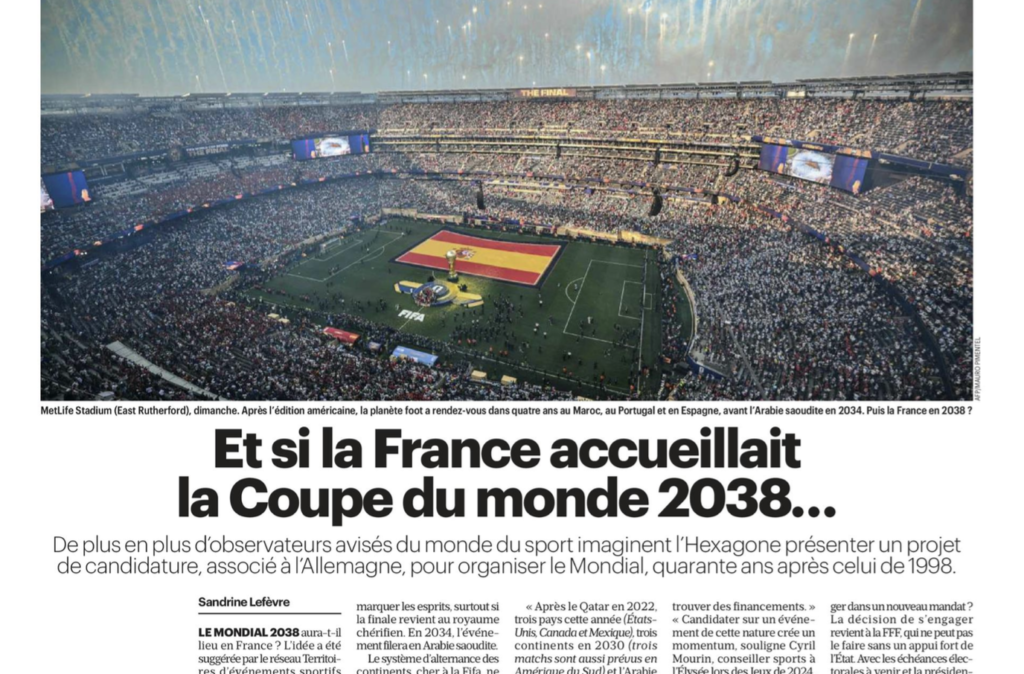
Le Parisien asked me this week about a question that deserves better than a shrug: what if France hosted the 2038 World Cup? (link to the article, in French)
I am wary of reflex bids — the ones launched for the pleasure of being a candidate. But I am just as wary of renunciation on principle. Between the two lies a demanding path: asking the right questions before deciding. That is precisely what the report on the future of France’s major stadiums submitted by Territoires d’Événements Sportifs (TES) to the Minister for Sport proposes — and I had the pleasure of taking part in its presentation at the Stade de France, on the sidelines of the Top 14 final, which inspired this article.
What the TES report says
Commissioned in late 2024 by the Ministry of Sport, the report begins by recalling a century-old constant: it is major international events that built and modernised our stadiums — from the 1938 World Cup to Euro 2016, via the “grands stades” drive of Euro 1984 and France 98 — and it is local authorities, owners of most of the venues, that carried the bulk of the effort.
Its diagnosis is clear-eyed: a new wave of modernisation will be needed in the medium term, to meet technical standards and environmental requirements alike. But its real strength is refusing to treat this as an end in itself. Upgrading a stadium only makes sense if it durably strengthens the resident club’s business model, and broadens the venue’s uses and its contribution to the local area. No one-size-fits-all logic, no major works everywhere: projects calibrated to each territory’s actual needs and to the sustainability of public investment. That is exactly the right framework.
A bid is not an end in itself — it is a lever
Why, then, look to 2038? Because a bid for an event of this nature creates momentum. It brings everyone to the table and forces issues that would otherwise keep waiting: the business model of our major stadiums, how to secure it over time, their modernisation. It also showcases our infrastructure, our expertise, the whole of France’s sports economy. And yes, it promises great emotions. That is not nothing — but it is not enough.
Let us be lucid about the calendar: continental rotation does not favour Europe in 2038. But FIFA awarded the 2030 and 2034 editions at a single congress, in December 2024. If it proceeds the same way again, 2038 and 2042 will effectively form a single rendezvous. That is how a French bid should be conceived: one project, two windows. And probably not alone: the specifications now require 14 to 16 large-capacity stadiums, which argues for a partner such as Germany — with, a century after the Second World War, a resonance reaching far beyond football.
Local authorities as co-producers of the project
This may be the most important point, and the TES report makes it well: local authorities can no longer be treated as mere host cities, called upon once the project is wrapped up. Even more than at Euro 2016, they will matter in the very crafting of the bid and the definition of the project. They own the stadiums, they know their territories, and it is at their level — rather than in national macro-figures — that the direct and indirect returns of such an event should be assessed: jobs, orders for local businesses, attractiveness, legacy uses, and the momentum generated across all our territories to facilitate and develop football and sport.
Financing, without naivety
There remains the question that conditions everything: how to finance it, when so many other public-spending priorities legitimately compete? The answer lies in the quality of our stadium stock. Thanks to Euro 2016 and the Paris 2024 Games, France does not need to rebuild its stadiums. Targeted improvements will suffice — and these would best be carried by the operators themselves, the clubs, so that every euro invested serves first their own business model and the area surrounding these venues. That is the virtuous convergence the TES report sketches out: clubs more involved in the management and operation of their stadiums, local authorities refocused on their role as regulator and guarantor of territorial roots. A successful bid is not one that builds for a month of competition; it is one whose works serve thirty years of local life.
A World Cup designed for its times
Finally, there is a question no serious bid can any longer treat as an afterthought: the environment. A World Cup in 2038 or 2042 will be played in a world that will have changed, and what must be designed now is an event model embedded in a European adaptation strategy. That naturally implies exemplary infrastructure — energy sobriety, reuse, adaptation to tomorrow’s climate. But above all it means acting on a major event’s largest source of emissions: spectator travel. Let us own it: more affordable ticketing is the choice of favouring a European audience — one that can reach the stadiums by train and by low-carbon transport. Fewer spectators flying in from the other side of the world, more supporters coming from our regions and neighbouring countries: that is not a constraint to be endured, it is a project — a more sober, more accessible World Cup and, at heart, one truer to what makes the event valuable.
The will and the means
None of this can be decreed. The will and the means — the two conditions of a credible bid — have to be worked through: with willing local authorities, with the clubs, on financing, with our potential partners. After the 2027 Road Cycling World Championships, the Alps 2030 Games and the 2031 Basketball World Cup, France has momentum and the means to be usefully ambitious, on projects that make sense and deliver concrete effects for the country. Let us not skip steps — but let us not waste time either.
So, Philippe Diallo — shall we launch the preliminary studies?
Sideline Conseil
Échangeons sur votre situation
Une échéance réglementaire, un dossier sensible, une stratégie d’influence à construire ? Exposez-nous votre enjeu — nous vous dirons comment nous pouvons vous être utiles.
ou directement à contact@sideline-conseil.fr