
10 min read
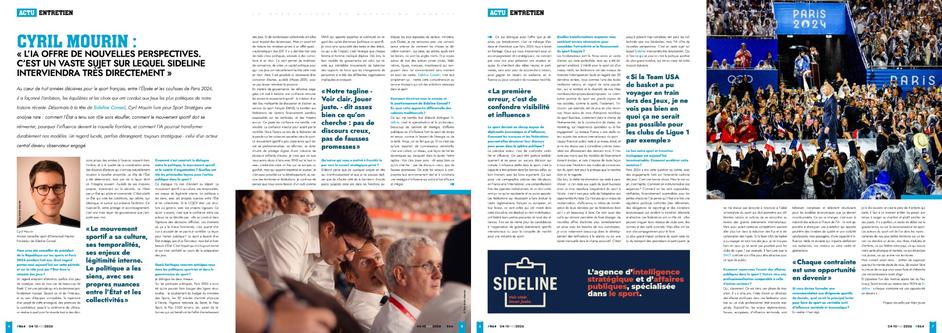
At the heart of eight decisive years for French sport, between the Élysée and the wings of Paris 2024, he shaped the ambition, the balances and the choices that led to the most political Games in our recent history. Now at the helm of Sideline Conseil, Cyril Mourin gives Sport Stratégies a rare analysis: how the state held its role without stifling it, how the sports movement must reinvent itself, why influence is becoming the new frontier, and how AI could reshape our models for the long term. A clear-eyed view, at times unsettling, always strategic — that of a central player turned engaged observer.
You advised the President of the Republic on sport and Paris 2024 for eight years. How do you look back today on that period and on the part the state played in the success of the Games?
I look back with emotion, sometimes a touch of nostalgia, but above all with great pride. It was, of course, a period that marked me deeply. When you live the trajectory of a project on that scale from the inside, alongside extraordinary teams — from the earliest days of the bid right through to the closing ceremony — you realise just how much success rests on decisions taken years in advance, often out of sight, and on the quality of coordination between dozens of stakeholders who are not naturally meant to work together. The state’s role was decisive, but not in the way people often imagine. Beyond its own responsibilities, on security in particular, this was not a state that directs and commands. It was, rather, a state that creates the conditions, that arbitrates, that unblocks, and above all that safeguards the ambition. That subtle balance, between steering and supporting, is a real lesson in governance, and one I carry with me.
“The sports movement has its own culture, its own timeframes, its own questions of internal legitimacy. The political world has its own too, with its own subtleties between the state and local authorities.”
How did the dialogue between the political world, the sports movement and the organising committee take shape? What were the main lessons for public action in sport?
That dialogue was anything but a given at the outset. The sports movement has its own culture, its own timeframes, its own questions of internal legitimacy. The political world has its own too, with its own subtleties between the state and local and regional authorities. And the organising committee was a sui generis structure, with a logic all its own. What we learned is that trust between these stakeholders cannot be decreed: it is built through the test of difficult decisions. The moments when things worked best were the ones where everyone agreed not to control everything. The lesson for public action? Sport needs a strategic state, not a supervisory one — but it does genuinely need the state. That is the conviction that has always driven me, and it only grew stronger as we prepared the Games.
What concrete legacies do you anticipate in sports policy and in the governance of sport?
I draw a distinction between the two levels. On public policy, Paris 2024 showed that we could move structural lines: doubling the budget of the Ministry of Sports, 30 minutes of daily physical activity in schools, the National Sports Agency (Agence nationale du Sport), the Pass’Sport scheme, the 5,000 Pitches Plan, and so on — all reforms that drew on the momentum the Games created. And many local and regional authorities set dynamics of their own in motion. But it would be a mistake to put these initiatives down to an almost “automatic” effect of the Games. Behind all of it lie real political choices, rooted in convictions and in a narrative. That narrative is what makes it possible to mobilise, to convince, to build the political capital you need in order to act. The Games naturally made that story easier to tell. But it is both possible and necessary to craft others, beyond Alps 2030, so as not to let the momentum slip.
On governance, the reforms we launched were meant to give form to renewed trust in the sports movement: the creation of a genuine multi-stakeholder forum for discussion and action in the service of French sport (the National Sports Agency), the transfer to federations of certain funding that had previously been spread thinly across local areas, and greater resources. That gesture of trust strikes me as irreversible. Trust does not, however, rule out oversight. We saw this when the silence around sexual violence in sport was broken. The sports movement realised it had to professionalise, to reform, to equip itself with management tools worthy of a multi-billion-euro industry. I believe that what we achieved with the National Sports Agency on elite sport — namely, creating a body that is not a mere grant window but one that brings expertise and support — can be done just as well on grassroots development, in the service of local areas and federations. I remain convinced that we need a body like the National Sports Agency to provide expertise and continuity that hold up against the electoral cycles, political and sporting alike.
I also believe that, beyond texts and statutes, what truly makes a difference is the energy that each woman and man involved brings to the table. From there, the right governance model is the one that withstands the inevitable swings in the balance of power that come every time the people leading the various organisations change.
“Our tagline — Read the game. Shape the outcome. — captures pretty well what we are after: no empty talk, no false promises.”
What made you decide to take the step into private strategic consulting?
First, because I have a few projects in mind that genuinely excite me and that I could only pursue from “the other side of the fence.” And second, because after eleven years in the most exposed public roles in the sector — the Ministry, then the Élysée — I came away with a precise understanding of how things really get decided: who carries weight, who arbitrates, where the levers are, where the blind spots lie. And I saw private players around me — clubs, federations, leagues, brands, investors — navigating this environment without really knowing the codes. Sideline Conseil is quite simply that: putting this understanding at the service of those with serious ambitions in sport.
How would you describe Sideline Conseil’s mission and positioning? How does this approach differ from traditional firms?
What sets Sideline apart first, I think, is its specialisation and its depth. Plenty of strategy, public affairs or influence firms dip into sport now and then, the way they might dip into energy or healthcare. We do nothing else. And this is not just about sector knowledge; it is a culture, a network, a way of reading the dynamics that can only be acquired over time. Our tagline — Read the game. Shape the outcome. — captures pretty well what we are after: no empty talk, no false promises. We help players understand their real environment and build an influence strategy that is both effective and grounded in integrity.
What also sets apart the offering I am building — by temperament — is that blend of boldness and ambition that Paris 2024 left us as a legacy. Those who bring us in for what they call “strategic” support are not coming to protect the status quo. They are looking for fresh, relevant ideas, willing to surprise where it counts, in order to gain in impact, in reach, in influence, or to break into new markets.
“The first mistake is to confuse visibility with influence.”
Sport is becoming a major arena for economic diplomacy and influence. How can brands and federations shape their message to carry weight in the public sphere?
The first mistake is to confuse visibility with influence. You can be everywhere in the media and still carry no weight on any decision that matters. Real influence in sport is the ability to be in the right rooms, at the right moment, with the right arguments. That calls for precise mapping of decision-makers, in France and internationally, a sharp grasp of institutional agendas, and a coherent narrative about what you stand for and what you bring. The federations that manage to shift the regulatory framework, French or European, in their favour are the ones that have invested in this discipline, deployed a mobilising narrative, brought their stakeholders together and forged alliances. The same is true of bids to host major international sporting events, or of an industry setting out to win new markets in sport.
What major changes still seem necessary to you to strengthen the appeal and the funding of French sport?
The fundamentals are there. We have a framework for action that is still imperfect, but that has been considerably improved. Interest in sport is at an unprecedented level, federations have registered-member numbers that are historically high relative to the past 20 years, and, for the size of our population, we are one of the very best nations in the world for the number and diversity of our world, Olympic and Paralympic titles. Sport’s positive contribution to the great challenges facing our societies — health, isolation, inclusion — is increasingly recognised. We have genuine world champions in the sports business, in particular in events, stadium construction, marketing, the spectator experience and fan engagement. Brand France carries real value among international players in sport.
Public funding remains at a high level, and I refuse to accept its erosion over recent months as inevitable. That said, funding models do have to evolve — and in any case this is being forced upon us by the changing ways sport is consumed, both in how it is played and in how it is watched.
From there, the real transformation still to be completed — sticking to sports business, otherwise I would talk to you at length about sport in schools — is, to my mind, adapting to the opportunities of AI and data. This is not just a matter of modernisation, of efficiency, or even of federations monetising their data, though there is a great deal to be done there. These are also tools that should help bring forth new activity offerings, more directly attuned to the needs of our fellow citizens. I believe in particular in developing pay-per-session or monthly pricing in the grassroots and voluntary sector. Until now this has been too complex, both for local authorities and for our volunteers, but AI opens up new possibilities. It is a vast subject, and one Sideline will be very directly involved in. Because what is ultimately at stake here is sport for the many, which lies at the heart of our founding mission.
“If the US basketball team could travel by train during the Games, I don’t quite see why it wouldn’t be possible for Ligue 1 clubs, for example.”
The link between sport and the ecological transition is now unavoidable. How can this shift be accelerated?
Paris 2024 put this question front and centre, with strong commitments on the Games’ carbon footprint. That is a good thing. But the real issue is what comes next. How do we institutionalise these requirements? How do we make them enforceable, verifiable, financially sustainable for small organisations? I think we need both a stronger public framework — standards, reporting obligations — and economic incentives that make the transition desirable and appealing. Federations have a key role: they can feed concrete norms and tools through their club networks. But they need support to do it.
The biggest carbon impact of sport remains the transport of spectators and participants. I am not (yet) resigned to giving up on the universalist ideal of sport, which should let different nations and cultures meet through major international events. That said, some competitions can go further in cutting flows and decarbonising travel. If the US basketball team could travel by train during the Games, I don’t quite see why it wouldn’t be possible for Ligue 1 clubs, for example. The SNCF simply needs to strengthen its offering to make it appealing to this kind of audience.
How do you see the future of public affairs in sport? Are we heading towards a level of professionalisation comparable to that of other sectors?
Yes, clearly. We are in a transition phase. Five years ago, the idea of having a director of public affairs in a sports federation or a professional club was still marginal. Today, the regulatory, fiscal, European and local-influence stakes are so complex and so defining for business models that it is becoming essential. What will also change is the maturity of these players in the age of AI: they will learn to tell the difference between a service that may deliver quality outputs and decent but fleeting visibility, and a real, lasting capacity for influence that genuinely shapes your audiences, your revenues or your regulatory framework.
“Every constraint is an opportunity in the making.”
If you had to offer one piece of advice to the sports leaders of tomorrow, what would be the main lever for making sport a true instrument of societal and economic influence?
In reality, it already is one. I often say this, and it is the father of four speaking: at some point you have to stop spending all your time tidying your room and actually enjoy your toys. There is sometimes too much debate about governance, or about the recognition of sport. The players in sport are holding gold in their hands: some of our finest emotions, on the field or in front of a screen; our dreams as adults and as children; what brings our country together; what protects our physical and mental health; what empowers our young people; what brings our local areas to life.
So my advice would be this: stop assuming that everyone doubts you, stop trying to prove what you can do, and stop waiting for recognition before you act.
And I would add one of the mantras learned on rue du Faubourg Saint-Honoré that will stay in Sideline’s DNA: “every constraint is an opportunity in the making”…
Interview by Alain Jouve — Sport Stratégies, no. 864, 4–10 May 2026. Reproduced with the kind permission of the editorial team.
Sideline Conseil
Échangeons sur votre situation
Une échéance réglementaire, un dossier sensible, une stratégie d’influence à construire ? Exposez-nous votre enjeu — nous vous dirons comment nous pouvons vous être utiles.
ou directement à contact@sideline-conseil.fr