
France’s Finance Bill for 2027 (PLF) has been tabled. As every year, the debates that will surround it, as far as sport is concerned, will handle a variety of figures, which lead to different interpretations depending on each person’s leanings. I shall try here to put them back into perspective. In summary, my reading for 2027 is a concerned one: direct appropriations for sport are falling, a large part of that fall being due to the removal from the State budget of Pass’Sport (a means-tested grant towards young people’s club membership fees), whose future funding remains to be clarified. Depending on the answer given on this point, 2027 will be either a year of near-stability at a rather low level, or one of the lowest sport budgets since 1998.
The “Sport, Youth and Community Life” budget mission is presented as stable; excluding the 2030 Winter Games, however, direct appropriations for sport fall by 8.7%. The parallel is telling: €48 million more for the Games, 47 less for the Sport programme. One must nevertheless look at what this fall covers: for the most part, around €40 million, it would appear to correspond (I am bound to use the conditional…) to Pass’Sport, which the government is transferring to the network of family allowance funds, the CAF (which have a fair degree of freedom over their funds…). Everything therefore depends on what becomes of this funding, and the budget documents do not yet say. One point is settled: payments for the Games will ramp up until 2030, within a mission presented as stable.
If Pass’Sport is not taken over at an equivalent level, and if outturn follows the pace of the freezes and cancellations observed since 2023, the State’s actual spending on sport could return to its 1998 level, or even fall below it. This is a hypothesis to be watched closely…
But the parliamentary debate is beginning, and as is often the case it may allow the government’s initial draft to be amended. To inform it, I have therefore tried to clarify the questions of scope, the relevant points of comparison and what I believe to be recurring analytical biases, which divert the debates from the real issues. This page brings together the essentials so that everyone can form their own opinion: the orders of magnitude of French sport funding, the real mechanics of earmarked taxes, thirty years of budgets as voted and above all, as I shall come back to, as spent, the detailed breakdown of 2026 spending, and a few more personal keys for reading official communication.
Contents
- A €51 billion economy, funded first and foremost by households
- Earmarked taxes: understanding the plumbing before debating it
- Fifteen years of budgets: what is voted, what is spent
- Where the State’s money for sport goes
- Five keys to reading official communication
- Beyond the sport appropriations: what the 2027 texts also change for the sector
1 · The context
A €51 billion economy, funded first and foremost by households
National sports expenditure amounts to around €51.3 billion, or 1.8% of GDP1. A more flattering figure often circulates, of around €78 to 80 billion: it measures something else, the economic weight of the sport sector, that is, what it produces, whereas national sports expenditure measures who pays1. It is borne first and foremost by households: €27.6 billion, more than half of the total, in federation licences, membership fees, equipment, subscriptions or ticketing2. Together with businesses, the private sphere funds nearly six tenths of the whole; the public share nevertheless exceeds 40% once corporate philanthropy, sponsorship and the tax expenditure that goes with them are properly counted1.
A second lesson, sometimes forgotten: the State’s weight comes first through schools. Of its €8.5 billion, 6.5 fund school physical education (PE), from primary to upper secondary school3, and 0.6 the tax expenditure linked to corporate philanthropy. The “Sport budget” in the strict sense, the one Parliament will debate, combining the appropriations of the Sport programme and earmarked taxes, excluding the Games, amounts in 2026 to around €0.77 billion4: less than 2% of national sports expenditure. Local authorities, for their part, devote €12.5 billion to it, of which 8 for municipalities alone5, not counting facilities made available free of charge: the real public pillar of everyday sport.
The State versus local authorities: a comparison to be handled with care
A word, in passing, on a ritual comparison that must be handled with care: setting the State budget against the €12.5 billion of local authorities in order to conclude that the one is disengaging or that the others are virtuous. The scales are skewed four times over. A single actor is being compared with the sum of tens of thousands of municipalities, intermunicipal bodies, départements and regions. It is forgotten that part of local spending is made possible by the State, whose financial transfers account for nearly a quarter of the operating revenue of the municipal tier5. The roles also differ: it is not for the State to subsidise the neighbourhood association or to carry the construction of a gymnasium. And the State sets the standards, those for facilities, qualifications, safety and the delegations granted to federations: an actor’s weight does not rest on its budget alone. If one insists on comparing, let us do it properly: excluding debt servicing, defence and pensions, all of them burdens that local authorities by nature do not bear, the State’s “comparable” budget is close to €280 billion, of which 3% goes to sport in its broad sense, including school sport; sport, for its part, accounts for 6.3% of municipalities’ budgets6. Framed in this way, the comparison becomes useful again: it sets out objectively who does what, and is a reminder that everyday sport is first and foremost a local matter.
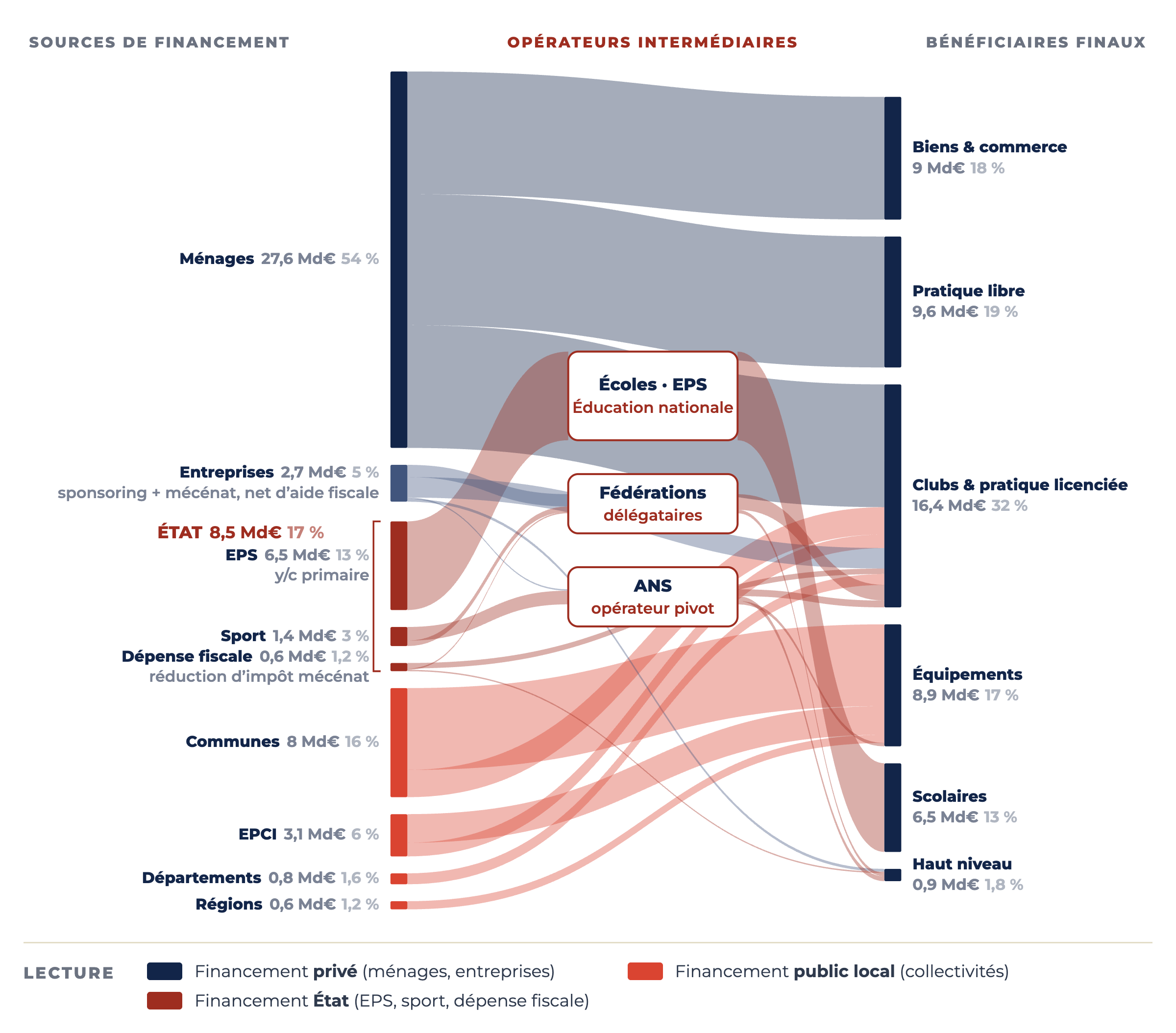
That is the framework. The discussion of PLF 2027 therefore concerns a modest, but strategic, fraction of the whole: the appropriations of the Ministry of Sport and the taxes earmarked for the National Sports Agency (ANS). It is this fraction that needs to be looked at closely.
2 · The mechanics
Earmarked taxes: understanding the plumbing before debating it
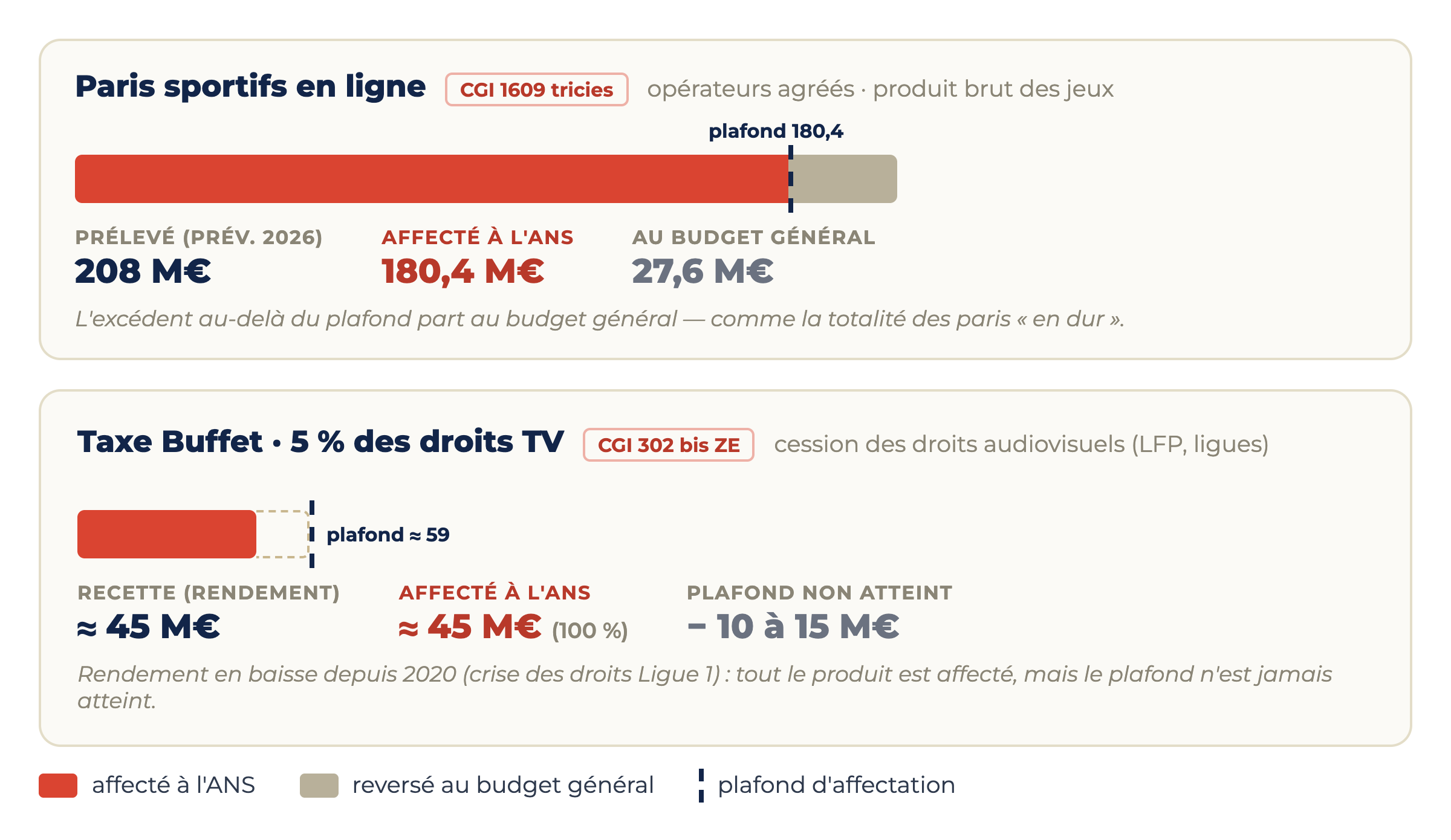
Sport benefits from two so-called “earmarked” taxes: a levy on online sports betting and the “Buffet tax”, based on the sale of broadcasting rights. The principle is simple, the mechanics less so. For each tax, the revenue collected must be distinguished from the amount actually earmarked, because a cap voted each year limits what is transferred to the ANS; the surplus stays in the general budget.
In 2026, online sports betting is expected to bring in €208 million, of which 180.4 is actually earmarked for the ANS (the cap) and 27.6 is returned to the general budget7. The Buffet tax brings in around €45 million, fully earmarked: its cap, set at 59, has no longer been reached since its yield dropped away with the Ligue 1 TV rights crisis. PLF 2027 carries the whole arrangement over unchanged: same caps, same yield forecasts11.
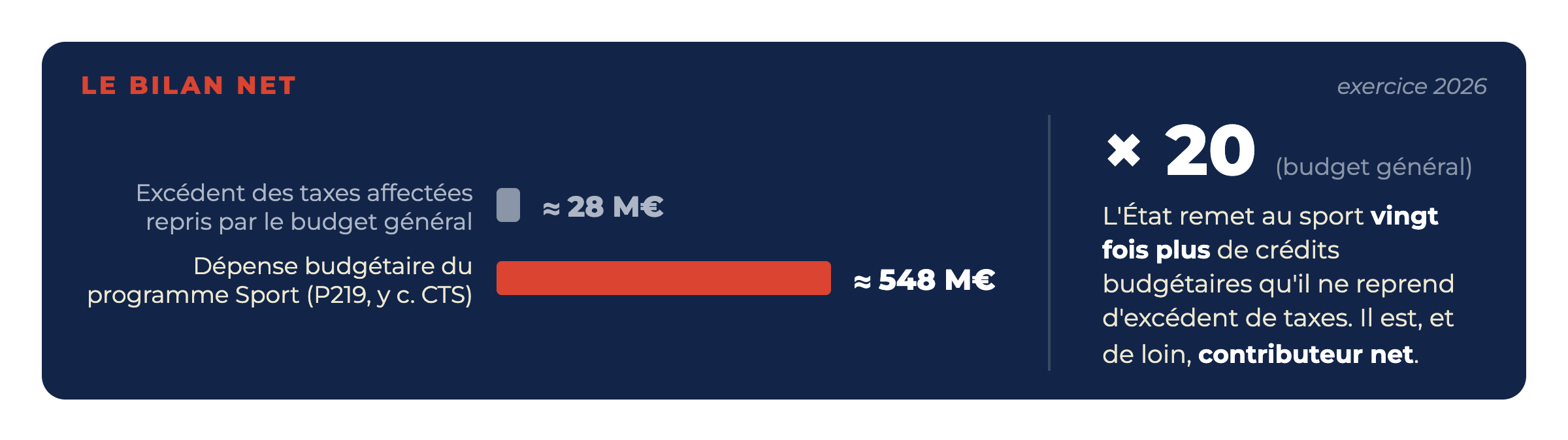
The decisive point lies elsewhere: these taxes do not fund French sport, at any rate not in the sense claimed in public debate. In 2026, the State hands sport, through its budget appropriations, twenty times more than the surplus of taxes it takes back: around €548 million on one side, 28 on the other8. It is, by a wide margin, a net contributor.
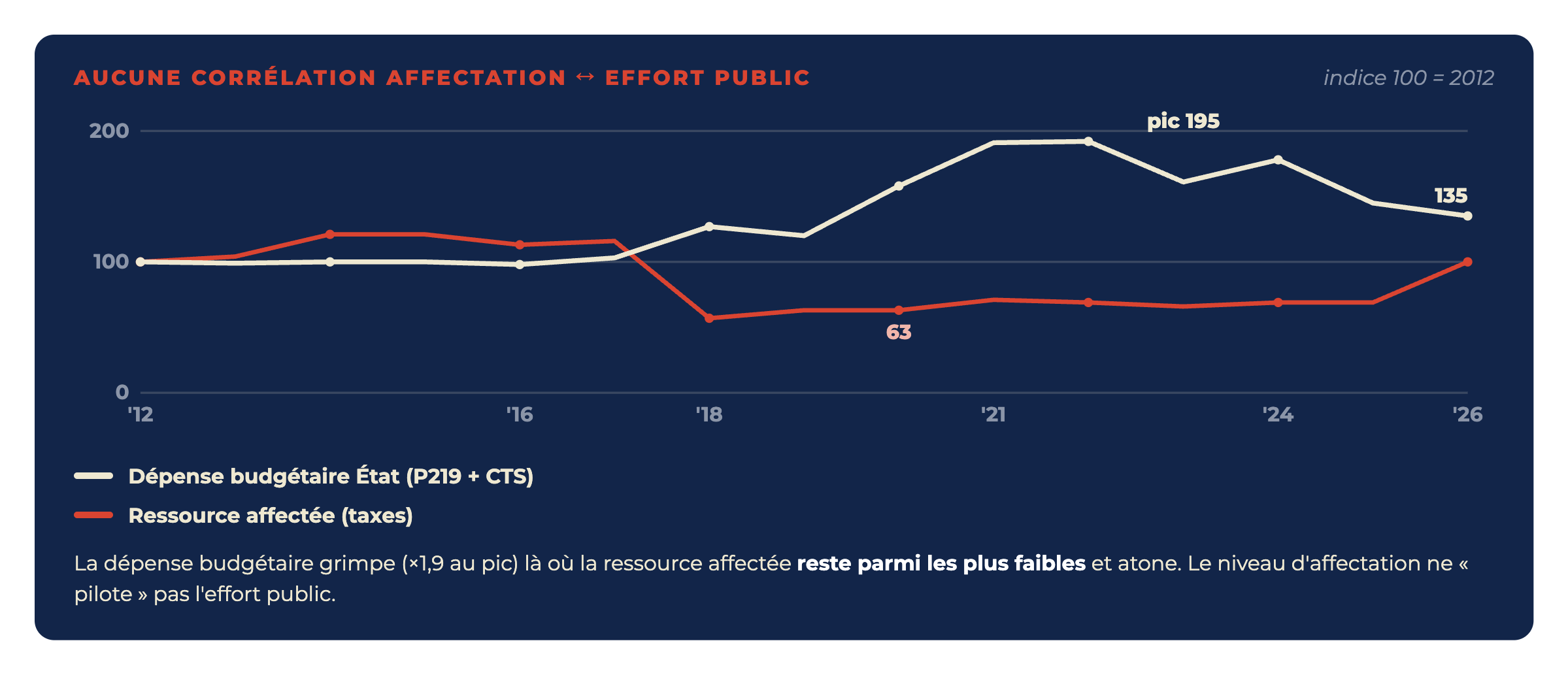
Fifteen years of history confirm it: the level at which taxes are earmarked has never driven the public effort. The State’s budget spending almost doubled up to the 2021 peak, while the earmarked resource, cut in 2018 to below its yield, remained flat. The two curves lead separate lives.
“Lifting the cap”: a debate to be put back in its place
Every autumn, fully lifting the cap on earmarked taxes is presented as the solution to the funding of sport. As an order of magnitude: it would bring in around €28 million, or 5% of the Ministry’s appropriations. The demand is legitimate; it does not change the equation. The real effort is played out in the appropriations voted and, above all, in their outturn.
The real debate is not the cap, it is the tax base
Once lifting the cap has been brought back to its order of magnitude, a more serious, and rarely asked, question remains: that of the tax base. The tax partially earmarked for the ANS is in fact only a small part of the taxation that specifically falls on sports betting activity. In 2027, the State expects €949 million from it for its general budget, to which are added the €180 million earmarked for the ANS: more than €1.1 billion in total, not counting €0.3 to 0.4 billion in social levies paid to social security9. Set against the core sport budget, State taxation of sports betting alone thus represents one and a half times all the appropriations the State devotes to sport. In a broader and more ambitious approach, some will therefore take the view that the whole of this taxation should be directed to sport: there, unlike lifting the cap, the equation would genuinely change in nature.
A serious objection nevertheless awaits the advocates of such full earmarking, and it will have to be answered: is it healthy, and all that reassuring, to tie the funding of sport durably to taxation based on the encouragement of betting? The resources of sport would then follow the dynamics of sports betting, its surges as well as its reversals, and the State would find itself in the position of having an interest in the French betting more.
I would add a more personal conviction, which follows from the previous point: if every public policy were in this way to obtain “its own” earmarked taxation, a tax on the sick to pay for health, on show ticketing to remunerate culture, on betting to fund sport, it is the very principle of taxation that would unravel. I remain an advocate of taxation that respects democracy: revenues that are pooled, then elected representatives who set priorities and vote resources, and take responsibility for doing so. Tax that is pooled and then deliberated is national solidarity; generalised earmarking would be a way of circumventing it.
3 · The trajectory
Fifteen years of budgets: what is voted, what is spent
To judge a budget trajectory, two methodological requirements apply. The first is consistency of scope: over the years, entire envelopes migrate from one line to another, as with the technical sports advisers (CTS), brought in 2020 into the budget of the ministry responsible for sport after having come under the national education workforce; comparing years without restating these transfers simply makes no sense. The second is monetary consistency: everything here is converted into constant euros (2026 base), so as to read changes in real purchasing power and not nominal illusions. The chart below therefore consolidates, from 2012 to 2027, the Sport programme (CTS reintegrated), the resources of the National Sports Agency and the appropriations dedicated to the Games. And it sets, for each year, the Finance Act as passed against the spending actually carried out: I stress this, because that is where everything is decided, truly. It remains imperfect, let us own that: for consistency of scope, one could for example neutralise the bonuses for Olympic and Paralympic medallists, paid every other year.
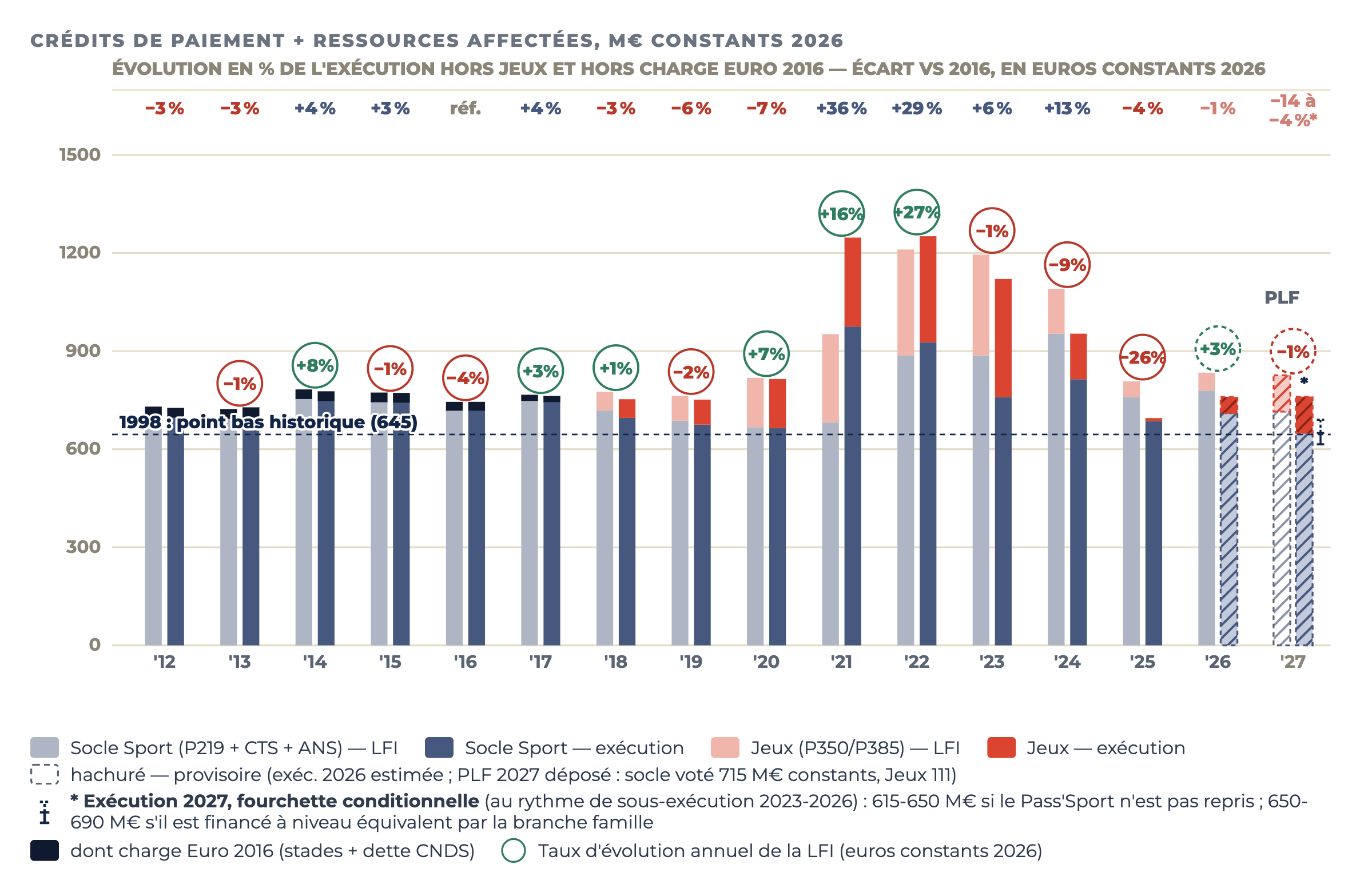
Three lessons emerge. The core erodes over the long term: excluding the Games, outturn goes from €727 million in 2012 to 686 in 2025 in constant euros, a real-terms fall that the rise in current euros masks10. The 2021-2024 interlude was exceptional: the recovery plan, the preparation of Paris 2024 and the roll-out of new, large-scale public policies (Pass’Sport, the 5,000 sports facilities plan, 30 minutes of daily physical activity, 2 hours of sport in lower secondary school) took outturn up to 36% above its 2016 level.
The third lesson calls for more caution, and PLF 2027 gives the measure of it. The text as tabled shows a “stable” mission at €1,251 million. Excluding youth and community life, €613 million remains for sport and the Games; and within that total, excluding the Games, direct appropriations for sport (programme 219) fall from 548 to €501 million, a nominal fall of 8.7% and around 10% in constant euros, while the earmarked taxes are simply carried over11. The arithmetical parallel is clear: €48.7 million more for the French Alps 2030 Winter Games, 47.4 less for the Sport programme. It would nevertheless be hasty to conclude from this that the Games are funded by drawing an equivalent amount from everyday sport: most of the fall, in the order of €40 million, would appear to correspond to the removal of Pass’Sport from the State budget (see the box below), and the bonuses for the Milan-Cortina medallists, paid in 2026, are logically not renewed. In total, the core sport budget as voted, taxes included, would stand at around €715 million in constant euros: the lowest level voted since 2020. And this is where the underspend matters, because since 2023 actual spending has each year remained 9 to 15% below the vote. At the same pace, the 2027 outturn would lie between €615 and 650 million in constant euros, below the level of 1998, the lowest in our thirty-year series12. Even adding the appropriations for the Games, total spending would return to its floor levels. These figures must however be read with the foregoing reservation: if Pass’Sport is indeed funded at an equivalent level by the family branch of social security, the public effort in favour of sport, all funders combined, would lie rather between €650 and 690 million, that is, in the vicinity of that low point rather than below it. There remains a trend which, for its part, does not depend on this question: the Winter Games committed €400.7 million in commitment authorisations as early as 2026, payments on which will ramp up until 2030; with a “stable” mission, the room available for sport excluding the Games will mechanically shrink in 2028 and 2029. But this budget is not yet set in the stone of an Act as passed: the text as tabled is only a starting position, and Parliament may decide otherwise. That is the whole point of the debate now opening.
PLF 2027 in figures · Sport, Youth and Community Life mission (payment appropriations)
| Programme | 2026 Finance Act | 2027 Finance Bill | Change |
|---|---|---|---|
| 219 · Sport | €548.3m | €500.8m | −8.7% |
| 163 · Youth and Community Life | €647.0m | €637.9m | −1.4% |
| 385 · Alps 2030 Winter Games | €63.6m | €112.3m | ×1.8 |
| Mission | €1,258.9m | €1,251.0m | −0.6% |
Within the Sport programme, the payroll of the technical advisers is preserved (€130.1m, 17 fewer full-time equivalents) and operating expenditure is stable: the entire fall is borne by intervention spending (ANS, Pass’Sport, federations), which goes from €329.6m to €285.8m, i.e. −13.3%. The programme’s commitment authorisations fall by 13.8%, mortgaging subsequent financial years11.
Pass’Sport: a transfer that remains to be documented
The budget press kit states that Pass’Sport “is transferred to the network of family allowance funds”. Some press articles indicate that this transfer covers both the management and the funding of the scheme, for a saving of around €40 million on the Sport programme15. The figures in the Finance Bill are consistent with this reading: the programme’s intervention spending falls by €43.7 million, even though the resources of the National Sports Agency are rising.
This would therefore be a case of expenditure being moved off the State budget: the spending does not necessarily disappear, it leaves the State budget. Two readings are then possible, and I think it honest to present them both. On a like-for-like scope, that is, neutralising this transfer as I do above for the technical advisers, the fall in sport appropriations is limited, in the order of €7 million, or roughly the amount of the Olympic bonuses not renewed; this is the reading that allows the Ministry to speak of a “slight fall”. From the point of view of the State’s budgetary effort, on the other hand, it is indeed €47 million less.
What will decide between these two readings is the actual funding of the scheme in 2027, and at this stage I can find no trace of it: the transfer does not appear among the scope measures in the Finance Bill, and the Social Security Financing Bill (PLFSS) mentions no new resource for this purpose, while it also provides for a slowdown in spending by the national social action fund of the family branch of social security. This does not mean that Pass’Sport will not be funded; it means that its level is, for the time being, not guaranteed by any text. And having experience of certain State decisions not being implemented by the National Family Allowance Fund (CNAF) and the CAF, I am honestly very pessimistic about the very future of Pass’Sport. This is a question to be asked during the parliamentary debate, and a point to be checked in the budget annexes yet to be published.
Let us widen the lens one last time, for it gives the measure of the drop. The sport budget was built in stages: a plateau of between €630 and 670 million in constant euros in the mid-1990s, a low point of 645 in 1998, before the Buffet tax had even been created, then the increases of the 2000s, up to more than €800 million in 2004-2005, and then the significant efforts made from 2020 onwards, taking the budget for sport and the Games beyond the billion mark. The 1980s admittedly showed lower amounts still, around €450 to 580 million in constant euros, but for a State whose role in sport bore no comparison with today’s: no National Sports Agency, no structured high performance, no national schemes for access to participation. On a comparable scope of responsibilities, that is, since the French sporting model was built, a 2027 outturn at this level, were it to be confirmed, would be unprecedented12. That is why the question of Pass’Sport is not a technical detail: it separates a year of near-stability from a historic low.
4 · 2026 spending
Where the State’s money for sport goes
It remains to understand what these appropriations actually fund. In 2026, the State’s direct effort for sport, schools aside, mobilises around €835 million across all channels: €548 million in payment appropriations under the Sport programme, €225 million in taxes earmarked for the ANS and €64 million for the Alps 2030 Games.
2026 breakdown
≈ €835m: where the State’s money for sport comes from, and where it goes
2026 Finance Act (LFI), payment appropriations and earmarked taxes, in orders of magnitude · excluding school PE (€6.5bn) and tax expenditure
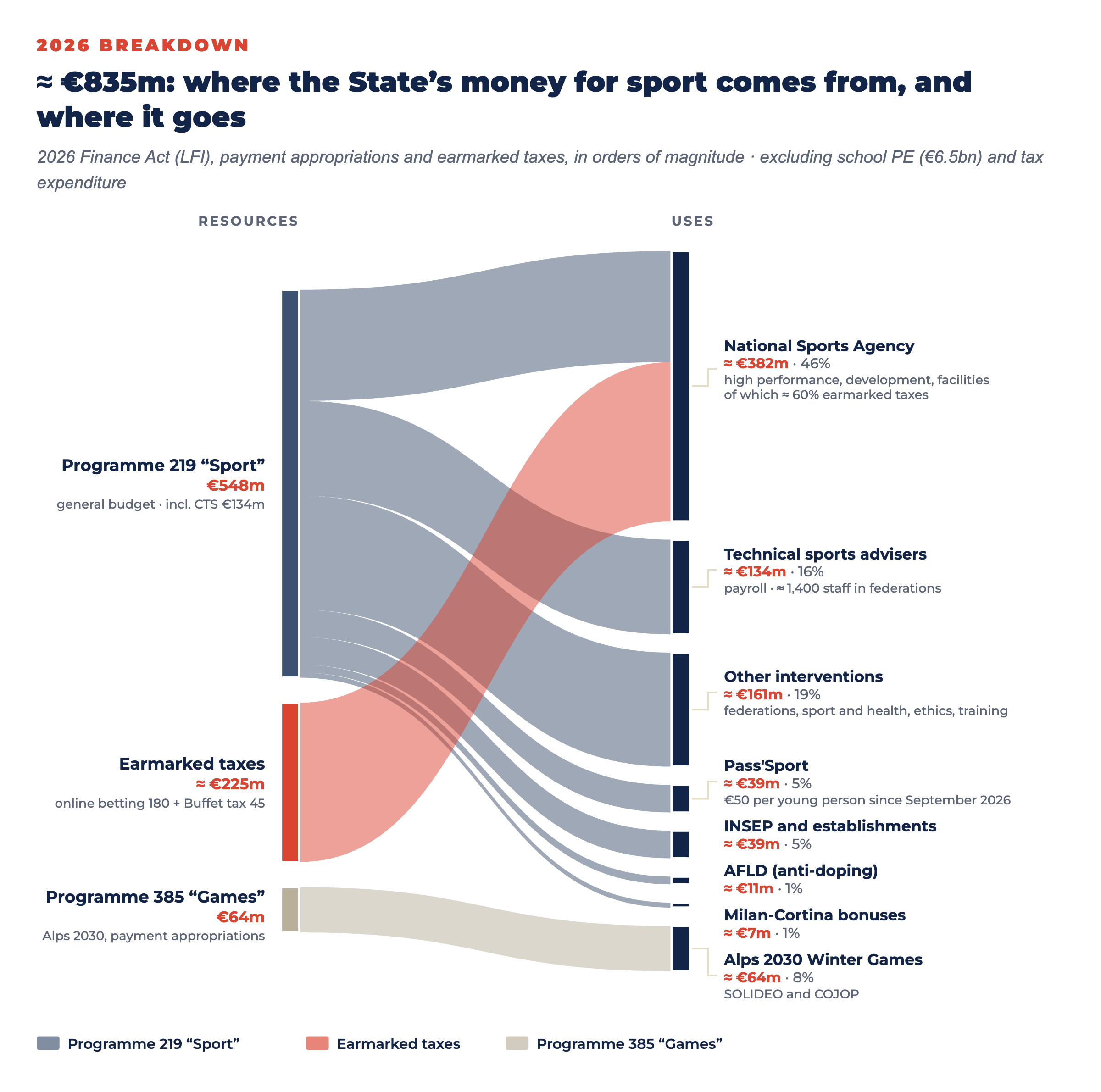
These figures can be read by dwelling on three blocks. The National Sports Agency concentrates nearly half of the resources (around €380 million, of which 60% earmarked taxes), which it divides between high performance on the one hand, and the development of participation and facilities on the other. Technical staffing forms the second block: €134 million in payroll for nearly 1,400 technical sports advisers placed with the federations. The remainder is split between the refocused Pass’Sport (around €39 million), the operators (INSEP, around €39 million; French Anti-Doping Agency (AFLD), €11 million), the bonuses for the Milan-Cortina medallists (€7 million) and the programme’s other interventions: support for federations, sport and health, ethics and integrity, training and employment. This mapping also helps in reading the 2027 fall: it bears neither on the salaries of the technical advisers, preserved save for 17 posts, nor on the National Sports Agency, whose resources rise slightly; it is concentrated on the programme’s intervention spending, and first of all on Pass’Sport, which leaves the State budget for the network of family allowance funds, as well as on the Olympic bonuses, specific to 2026.
The (2026) figures behind the chart
| Source | Use | €m | Share |
|---|---|---|---|
| P219 + earmarked taxes | National Sports Agency (high performance, development, facilities) | ≈ 382 | 46% |
| P219 | Technical sports advisers (payroll) | 134 | 16% |
| P219 | Other interventions (federations, sport and health, ethics, training) | ≈ 161 | 19% |
| P219 | Pass’Sport | ≈ 39 | 5% |
| P219 | INSEP and establishments | ≈ 39 | 5% |
| P219 | AFLD (anti-doping) | ≈ 11 | 1% |
| P219 | Milan-Cortina 2026 medallists’ bonuses | ≈ 7 | 1% |
| P385 | Alps 2030 Winter Games (SOLIDEO, COJOP) | ≈ 64 | 8% |
| Total | ≈ 837 | 100% |
5 · A user’s guide
Five keys to reading official communication
The PLF 2027 figures are now on the table, and their presentation follows the usual rules of budget communication: every figure announced is chosen. Here, more personal, are the keys I use to decode it.
- Current or constant?
The budget is presented as “stable”. Nominal stability below inflation is a real-terms fall: the first question to ask of any figure announced is which euros it is expressed in. - What scope?
The whole mission, with youth and community life, or the Sport programme alone? The Alps 2030 Games inside the envelope or on top of it? In 2027, the €112 million for the Games housed within a “stable” mission changes the whole reading; official communication will naturally choose the most flattering scope. The same vigilance applies in the other direction: the removal of Pass’Sport from the State budget lowers the Sport programme without our yet knowing whether the spending disappears or moves elsewhere. To assess direct spending in favour of sport, it is better to reason excluding the Games: in the case of Alps 2030, the link between this spending and national sport policies appears, at this stage, less direct than it was for Paris 2024. - What is presented is not what is voted.
A finance bill is a starting position, calibrated in anticipation of parliamentary amendments. The autumn of 2024 illustrated this: presented with a fall in the order of €130 million, threatened with further savings in the course of the debate, the 2025 sport budget was in the end adopted on a softened trajectory, after the mobilisation of local elected representatives, the sports movement and elite athletes13. Judge the text as tabled for what it is: an opening of negotiations. But let us note that here, the negotiation appears particularly closed… - What is voted is not what is spent.
Since 2023, in-year cancellations have weighed more heavily than changes in the vote. The real variable is the outturn; it can only be read a year later, in the annual performance reports. - Count the appropriations actually mobilised, not their origin.
The question is not where the money comes from, but how much is actually mobilised. Earmarked taxes, general budget, caps: the plumbing fascinates insiders and feeds press releases, but it says nothing about the real effort. Only one aggregate counts: the total appropriations actually committed to sport, on a like-for-like scope and in constant euros. It is that aggregate, and that alone, which this page tracks over thirty years.
6 · The other measures
Beyond the sport appropriations: what the 2027 texts also change for the sector
The Sport programme does not tell the whole story. Six provisions of the 2027 PLF and PLFSS, which have attracted less notice, deserve the vigilance of those involved in sport14:
- A “greened” VAT compensation fund (FCTVA): the VAT refund on local investment is refocused on mobility and the ecological transition, i.e. around €2 billion less for local authorities. Energy renovation aside, building or renovating a gymnasium, a swimming pool or a pitch will therefore cost more for municipalities, which own most of the stock of sports facilities.
- Effort asked of local authorities: a progressive contribution of €2.5 billion to the budgetary effort is introduced. As the leading public funder of sport, the local tier will also have to arbitrate on its grants to clubs; conversely, the DSIL rises by €200 million and the DGF by 150.
- Pass’Sport: the scheme is transferred to the network of family allowance funds. Beyond the question of its funding, discussed above, this is a change of point of contact that families and clubs will have to anticipate, or even a change in award rules that are already particularly restrictive.
- Sports employers: the PLFSS widens the base for the general reductions in social contributions to include pay supplements; organisations that pay bonuses, for matches or results, on modest salaries will lose out. Severance payments will moreover be subject to contributions above around €48,000, a threshold that the departures of coaches and executives in professional sport routinely exceed…
- Training: funding levels and apprenticeship support are maintained, but the regional envelopes specific to CFAs disappear. A point to follow for the sport and activity-leadership sector, a heavy user of work-based training.
- Gambling taxation: no new measure on sports betting, in either the PLF or the PLFSS, after the increases of 2025. The debate on the tax base, for its part, remains wide open.
And now: the parliamentary debate
The text as tabled is only a starting position, as we have seen. The coming weeks will show how Parliament takes up the text: the actual funding of Pass’Sport after its transfer, the level of intervention spending under the Sport programme, the resources of the ANS, the ritual amendments to lift the cap, whose real stakes, around €28 million, are now known to the reader. Lastly, one point to watch, beyond my subject: appropriations for youth and community life are also falling (€9 million less), a signal that the voluntary sector will be following. In the autumn of 2024, the mobilisation of local elected representatives, the sports movement and athletes had shifted the 2025 budget. But in the budgetary context we know, it will be harder for parliamentarians to secure gains on a text that might, in the end, not be adopted at all. Two outcomes are then possible. If Parliament has not reached a decision within the seventy-day period, the government may bring the provisions of its bill into force by ordinance: the text as tabled would then apply, without the hoped-for corrections. If the text is rejected, or cannot be promulgated before 1 January, a special law would provisionally carry over the 2026 appropriations, at the minimum needed to keep public services running, pending a budget, possibly until the next elections.
The full summary, in three pages
The visuals in this article are taken from our summary “Le financement du sport français”: the flows, the circuit of earmarked taxes, fifteen years of votes and outturn.
Notes
- Two measures coexist and must be distinguished. National sports expenditure (INJEP, Le poids économique du sport, 2023 data) answers the question “who pays”; we restate it to bring back in corporate philanthropy (Admical) and sponsorship (Nielsen Sports / Sporsora), and to reclassify as public expenditure the share reimbursed by the State under the corporate philanthropy tax reduction (art. 238 bis of the CGI). The often-cited figure of €78bn (2.7% of GDP) measures, for its part, the economic weight of the sport sector, that is, what sport produces (BPCE L’Observatoire de l’économie du sport, 4th edition; the commercial sector alone generates around €80bn in turnover, Union Sport & Cycle). The two approaches are complementary: one describes the funding, the other the economic activity.
- INJEP, 2023 data: household sports consumption (goods, services, licences and membership fees, ticketing).
- Method of calculation: the €6.5bn for PE is a conventional estimate (INJEP), obtained by valuing teaching time: pay and contributions of secondary-school PE teachers, and the share of primary school teachers’ service devoted to PE. It is not a budget line voted as such, but it is indeed real State expenditure.
- LFI 2026: payment appropriations of programme 219 “Sport” (€548m) and taxes earmarked for the National Sports Agency (around €225m), excluding programme 385 “2030 Olympic and Paralympic Winter Games”; details in section 4.
- INJEP, 2023 data, and Observatoire des finances et de la gestion publique locales (OFGL); the State’s financial transfers account for nearly a quarter of the operating revenue of the municipal tier.
- Sideline Conseil calculation, in orders of magnitude: 2026 general budget expenditure (Senate, general report on PLF 2026), excluding debt servicing and the Defence mission, pensions coming under a special account. Share of sport in local budgets: OFGL, 2026 preliminary report (2025 data, municipalities with more than 3,500 inhabitants).
- Revenue forecasts annexed to PLF 2026 (“Voies et moyens” volume) and earmarking caps (art. 46 of LFI 2012, as amended).
- LFI 2026, payment appropriations of programme 219 (including technical sports advisers); Sideline Conseil calculation.
- PLF 2027, statement A (revenue estimates), line “Prélèvement sur les paris sportifs”; share earmarked for the ANS: art. 1609 tricies of the CGI, based on gross gaming revenue; specific social levies: art. L. 137-20 et seq. of the Social Security Code, raised by LFSS 2025 (yields: ministerial reply, National Assembly); tax on online gambling advertising created in 2025. Aggregates: Sideline Conseil calculations.
- Annual performance reports (Finance Ministry), budget outturn notes of the Court of Audit, Act on the results of the 2025 financial year (art. 48 of the LOLF); Sideline Conseil calculations in constant 2026 euros (INSEE CPI).
- PLF 2027 as tabled: breakdown of appropriations by mission and programme, tables by title, staffing caps and statement of earmarked taxes; comparisons with LFI 2026 and Sideline Conseil calculations.
- Sideline Conseil reconstruction on a comparable scope: sport appropriations in the Finance Acts (historical aggregates, then programme 219), technical staffing estimated at constant fully loaded cost, FNDS then CNDS/ANS, the whole deflated into constant 2026 euros (INSEE CPI). Sources: Senate budget opinions and reports, National Assembly budget debates and Ministry of Sport documents for the financial years concerned; 1980-1992 and 1999-2001 aggregates partially reconstructed. The detail of the series, year by year, is available from Sideline Conseil.
- See in particular franceinfo, “Budget 2025: après la mobilisation de nombreux acteurs…”, 10 February 2025, and Décideurs du Sport (P. Bayeux), October-November 2024.
- 2027 budget press kit (general presentation, “Sport, jeunesse et vie associative” and “Relations avec les collectivités territoriales” factsheets, labour and employment section); PLFSS 2027 as tabled, in particular articles 6 and 7; annexes to PLF 2027. Sideline Conseil analysis.
- 2027 budget press kit, “Sport, jeunesse et vie associative” factsheet; News Tank Sport, 1 October 2026; PLF 2027 as tabled (appropriations by title, changes of scope) and PLFSS 2027 as tabled (trajectory of the family branch of social security). Sideline Conseil calculations and analysis.
Method and sources
Consolidated, like-for-like scope: programme 219 (technical sports advisers reconstructed prior to their integration in 2020), ANS/CNDS resources and Games appropriations (P350/P385), deflated into constant 2026 euros (INSEE CPI). Sources: annual performance reports (Finance Ministry), budget outturn notes of the Court of Audit, Senate budget opinions, Act on the results of the 2025 financial year (art. 48 LOLF), PLF 2027 caps notified on 15 July 2026. National sports expenditure: INJEP 2023, restated; corporate philanthropy Admical 2024; sponsorship Nielsen Sports / Sporsora 2026. 2026 breakdown: LFI 2026 and annexed documents, Senate opinions, ANS data; amounts in payment appropriations, orders of magnitude.
Sideline Conseil
Échangeons sur votre situation
Une échéance réglementaire, un dossier sensible, une stratégie d’influence à construire ? Exposez-nous votre enjeu — nous vous dirons comment nous pouvons vous être utiles.
ou directement à contact@sideline-conseil.fr