
3 min read
An opinion piece by Cyril Mourin, published in Jurisport (issue no. 251, April 2024).
Our societies are in crisis. There is nothing new in that. If anything, it is a constant — each new threat leading people to badly underestimate the scale of the ones that came before. Faced with this, there are only two kinds of temperament: to endure or to react, to complain or to adapt. The second group has no monopoly on naivety, any more than the first has one on clear-sightedness.
Much has been said about the effects of Covid on participation in sport. Some saw in it a weakening of our network of volunteers, or a drift away from organised structures that threatens our federation-based model. Others, more Schumpeterian in outlook, detected a new appetite for sport, fuelled by weeks of enforced inactivity, and with it the emergence of new ways of being active capable of reaching a wide share of the population. All of them were wrestling with the same question — what the sport of tomorrow might look like — the better to prepare for it.
Within that debate, the distinctive character and the potential of the Pass’Sport scheme have not always been fully grasped. Announced in late 2020 by Emmanuel Macron, against a backdrop of acute anxiety over the effects of the health restrictions, this 50-euro grant for millions of young people was first and foremost a social, emergency measure.
What sets it apart, of course, is that it directs major financial support — up to 100 million euros — at the demand side. The money is paid to the clubs that young people choose to join. So, beyond helping to revive membership — which hit a record high in 2023 — it has also pushed many clubs to adapt what they offer in order to capture these young people’s interest.
In light of its track record, the target groups and the amount of the Pass’Sport could be revised. Its leverage would no doubt be strengthened by focusing it on those furthest removed from sport — 12-to-18-year-olds — which would allow the grant’s face value for families to be raised.
When the scheme was designed, its authors never claimed that the social dimension — the question of cost — was the only reason, or even the main one, for taking up a sport. A recent publication by the ONAPS sets out the full range of factors at play, such as the enjoyment a sport brings or how close it is to home.
Given the sheer size of the audience it reaches, this grant was meant to be a chance to meet a core need among young people: flexibility in how they take part. The aim was to build a digital tool for finding and booking local activities — by the session or by the year — and even for connecting young people with teammates and opponents. The impact of sport on social ties would be multiplied many times over.
What this exposed was an arid continent: the poverty of our sports data — on the inventory of sports facilities, for instance, or on the digital tools clubs use to manage their time slots, their members and their volunteers. Everyone improvises, a handful of start-ups offer solutions, but there is no shared framework for producing this data, making it easy to use and setting the terms on which it can be shared.
It is not for the State to invent the “Doctolib” of sport. But it can create fertile ground to make France a leader in sports innovation. And we have done it before: for several years, the Ministry of Health drove a genuine digital revolution across the sector. Today, all the data produced by professionals talks automatically to new services, public and private, that are being rolled out for users — monespacesante.fr being one example.
This work has been set in motion in sport. Quietly. And yet here is an issue that should feed the thinking on the legacy of the 2024 Games, so numerous and so compelling are the technical and legal questions surrounding this data. The Pass’Sport could then be far more than a cheque — a digital tool with a powerful influence on the sporting culture of our young people.
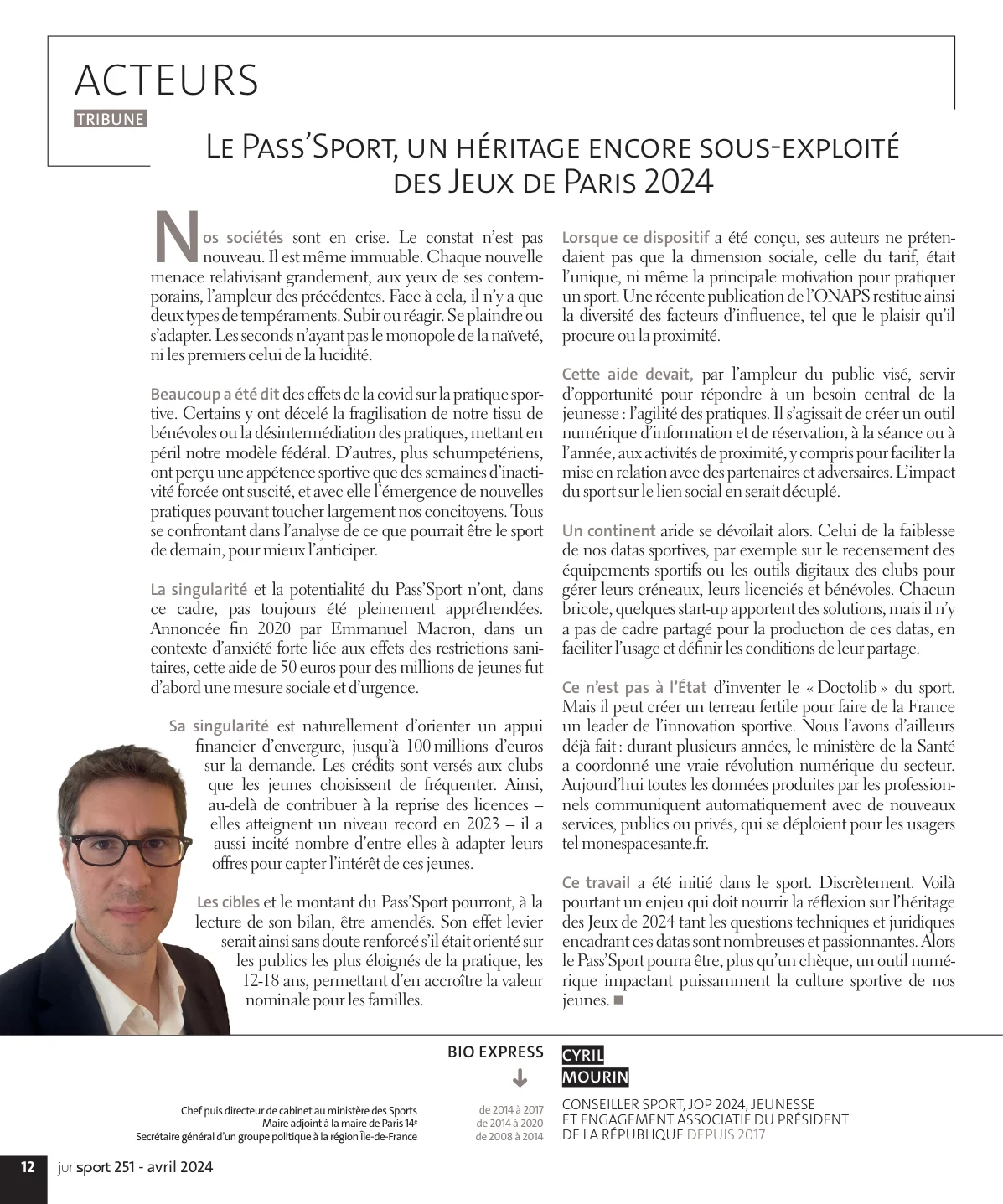
Cyril Mourin — Adviser to the President of the Republic for sport, the Paris 2024 Olympic and Paralympic Games, youth and community engagement (since 2017).
The opinion piece in Jurisport
Sideline Conseil
Échangeons sur votre situation
Une échéance réglementaire, un dossier sensible, une stratégie d’influence à construire ? Exposez-nous votre enjeu — nous vous dirons comment nous pouvons vous être utiles.
ou directement à contact@sideline-conseil.fr